CoboCards is a web application for creation, study and sharing of flashcards. They also provide mobile application for Android and iOS mobile devices, to help study of flashcards on the move. Based on the freemium model, CoboCards provides users a free account with two card sets compared to paid subscription with premium features such as unlimited card sets, Leitner system based trainer and collaborative learning. == History == CoboCards is a project of Jamil Soufan and Tamim Swaid. Tamim Swaid has developed the concept and interface of a collaboratively usable e-learning platform in his diploma thesis at the University of Applied Sciences in February 2007. In January 2010 they founded the CoboCards GmbH (limited company) together with Ali Yildirim. CoboCards is supported by its strategic partners Prof. Schroeder (RWTH Aachen University), Prof. Oliver Wrede (University for Applied Sciences Aachen) and Prof. Klaus Gasteier (University of Arts Berlin). With the idea of creating and studying flashcards online and offering an active control of learning progress they won the start2grow business idea competition in September 2009 (€25.000 ). Additionally CoboCards was funded by German Authorities with approximately €100.000 .
Mountain car problem
Mountain Car, a standard testing domain in Reinforcement learning, is a problem in which an under-powered car must drive up a steep hill. Since gravity is stronger than the car's engine, even at full throttle, the car cannot simply accelerate up the steep slope. The car is situated in a valley and must learn to leverage potential energy by driving up the opposite hill before the car is able to make it to the goal at the top of the rightmost hill. The domain has been used as a test bed in various reinforcement learning papers. == Introduction == The mountain car problem, although fairly simple, is commonly applied because it requires a reinforcement learning agent to learn on two continuous variables: position and velocity. For any given state (position and velocity) of the car, the agent is given the possibility of driving left, driving right, or not using the engine at all. In the standard version of the problem, the agent receives a negative reward at every time step when the goal is not reached; the agent has no information about the goal until an initial success. == History == The mountain car problem appeared first in Andrew Moore's PhD thesis (1990). It was later more strictly defined in Singh and Sutton's reinforcement learning paper with eligibility traces. The problem became more widely studied when Sutton and Barto added it to their book Reinforcement Learning: An Introduction (1998). Throughout the years many versions of the problem have been used, such as those which modify the reward function, termination condition, and the start state. == Techniques used to solve mountain car == Q-learning and similar techniques for mapping discrete states to discrete actions need to be extended to be able to deal with the continuous state space of the problem. Approaches often fall into one of two categories, state space discretization or function approximation. === Discretization === In this approach, two continuous state variables are pushed into discrete states by bucketing each continuous variable into multiple discrete states. This approach works with properly tuned parameters but a disadvantage is information gathered from one state is not used to evaluate another state. Tile coding can be used to improve discretization and involves continuous variables mapping into sets of buckets offset from one another. Each step of training has a wider impact on the value function approximation because when the offset grids are summed, the information is diffused. === Function approximation === Function approximation is another way to solve the mountain car. By choosing a set of basis functions beforehand, or by generating them as the car drives, the agent can approximate the value function at each state. Unlike the step-wise version of the value function created with discretization, function approximation can more cleanly estimate the true smooth function of the mountain car domain. === Eligibility traces === One aspect of the problem involves the delay of actual reward. The agent is not able to learn about the goal until a successful completion. Given a naive approach for each trial the car can only backup the reward of the goal slightly. This is a problem for naive discretization because each discrete state will only be backed up once, taking a larger number of episodes to learn the problem. This problem can be alleviated via the mechanism of eligibility traces, which will automatically backup the reward given to states before, dramatically increasing the speed of learning. Eligibility traces can be viewed as a bridge from temporal difference learning methods to Monte Carlo methods. == Technical details == The mountain car problem has undergone many iterations. This section focuses on the standard well-defined version from Sutton (2008). === State variables === Two-dimensional continuous state space. V e l o c i t y = ( − 0.07 , 0.07 ) {\displaystyle Velocity=(-0.07,0.07)} P o s i t i o n = ( − 1.2 , 0.6 ) {\displaystyle Position=(-1.2,0.6)} === Actions === One-dimensional discrete action space. m o t o r = ( l e f t , n e u t r a l , r i g h t ) {\displaystyle motor=(left,neutral,right)} === Reward === For every time step: r e w a r d = − 1 {\displaystyle reward=-1} === Update function === For every time step: A c t i o n = [ − 1 , 0 , 1 ] {\displaystyle Action=[-1,0,1]} V e l o c i t y = V e l o c i t y + ( A c t i o n ) ∗ 0.001 + cos ( 3 ∗ P o s i t i o n ) ∗ ( − 0.0025 ) {\displaystyle Velocity=Velocity+(Action)0.001+\cos(3Position)(-0.0025)} P o s i t i o n = P o s i t i o n + V e l o c i t y {\displaystyle Position=Position+Velocity} === Starting condition === Optionally, many implementations include randomness in both parameters to show better generalized learning. P o s i t i o n = − 0.5 {\displaystyle Position=-0.5} V e l o c i t y = 0.0 {\displaystyle Velocity=0.0} === Termination condition === End the simulation when: P o s i t i o n ≥ 0.6 {\displaystyle Position\geq 0.6} == Variations == There are many versions of the mountain car which deviate in different ways from the standard model. Variables that vary include but are not limited to changing the constants (gravity and steepness) of the problem so specific tuning for specific policies become irrelevant and altering the reward function to affect the agent's ability to learn in a different manner. An example is changing the reward to be equal to the distance from the goal, or changing the reward to zero everywhere and one at the goal. Additionally, a 3D mountain car can be used, with a 4D continuous state space.
Information logistics
Information Logistics (IL) deals with the flow of information between human or machine actors within or between any number of organizations that in turn form a value creating network (see, e.g.). IL is closely related to information management, information operations and information technology. == Definition == The term Information Logistics (IL) may be used in either of two ways: Firstly, it can be defined as "managing and controlling information handling processes optimally with respect to time (flow time and capacity), storage, distribution and presentation in such a way that it contributes to company results in concurrence with the costs of capturing (creation, searching, maintenance etc)." (Petri,2017) Thus IL utilizes logistic principles to optimize information handling. Secondly, IL can be seen as a concept using information technology to optimize logistics. A term which is closely related to the first meaning of Information Logistics is Data Logistics, a concept used in Computer Networking. "The study of solutions to problems in Computer Systems that flexibly span resources and services relating to Data Movement, Data Storage and Data Processing." [ref?] Systems that support general Data Logistics solutions thus must span the traditionally separate fields of Networking, File/Database Systems and Process Management. Data Logistics is a more general form of the term Logistical Networking, used as the name of a particular network storage architecture and software stack. == Goal == The goal of Information Logistics is to deliver the right product, consisting of the right information element, in the right format, at the right place at the right time for the right people at the right price and all of this is customer demand driven. If this goal is to be achieved, knowledge workers are best equipped with information for the task at hand for improved interaction with its customers and machines are enabled to respond automatically to meaningful information. Methods for achieving the goal are: the analysis of information demand intelligent information storage the optimization of the flow of information maintaining both security and organizational flexibility integrated information and billing solutions The expression was formed by the Indian mathematician and librarian S. R. Ranganathan . The supply of a product is part of the discipline Logistics. The purpose of this discipline is described as follows: Logistics is the teachings of the plans and the effective and efficient run of supply. The contemporary logistics focuses on the organization, planning, control and implementation of the flow of goods, money, information and people. Information Logistics focusses on information. Information (from Latin informare: "shape, shapes, instruct") means in a general sense everything that adds knowledge and thus reduce ignorance or lack of precision. In a stricter sense, raw data only becomes information to those who can interpret it. Interpreting relevant, related information produces insight that either leads to existing, or eventually builds new, knowledge. == Information element == An information element (IE) is an information component that is located in the organizational value chain. The combination of certain IEs leads to an information product (IP), which is any final product in the form of information that a person needs to have. When a higher number of different IEs are required, it often results in more planning problems in capacity and inherently leads to a non-delivery of the IP. To illustrate the concept of an IP, an example is shown of a bottleneck analysis in HR (by J. Willems 2008). Here, the illustration shows how the information elements (e.g. qualifications) build up the information product (e.g. HR file). == Data logistics == Data logistics is a concept that developed independently of information logistics in the 1990s, in response to the explosion of Internet content and traffic due to the invention of the World Wide Web (WWW). Some motivations for the emergence of interest in Data Logistics included: The incorporation of network hyperlinks into content encoded in HTML encouraged users to freely dereference those links without regard to, or in many cases without even having any knowledge of, the identity (much less the geographical or network topological location of) the target Web server. The growth in the volume of Web hits, combined with the steady increase in the size of Web-delivered objects such as images, audio and video clips resulted in the localized overloading of the bandwidth and processing resources of the local and/or wide area network and/or the Web server infrastructure. The resulting Internet bottleneck can cause Web clients to experience poor performance or complete denial of access to servers that host high volume sites (the so-called Slashdot effect). The growth in all Internet traffic, especially across international telecommunication links, resulted in stress to institutional infrastructure and high costs on networks that billed Internet traffic on a per-use basis. Much of this traffic was redundant, the results of repeated requests by many independent users to access the same stored files and content. Large files and content retrieved from distant Web servers was often delayed due to high delays experienced over long and complex Internet paths. These factors led to interest in the use of large scale storage (and to a lesser extent, processing) resources to cache the response to network requests, first at the Internet endpoint using a Web browser cache and later at intermediate network locations using shared network caches. This line of development also gave rise to Web server replication and other techniques for offloading and distributing the work of delivering large volume Web services to widely dispersed client communities, ultimately resulting in the creation of modern Content delivery networks. At the same time, research efforts in server replication and content delivery gave rise to a number of related projects and strategies, including Logistical Networking (LN). The name LN was intended as an analogy to physical supply chain logistics, in which goods are not only carried from source to destination on networks of roads, but are also stored at warehouses located throughout the transportation infrastructure. This led to a nomenclature in which LN network storage resources are termed "storage depots". The principles that underpin LN have been abstracted into the more general study of scheduling and optimization across the traditional infrastructure silos of Storage, Networking and Processing which was named Data Logistics. === Illustrative examples of data logistics === Data Caching and Replication are classic examples of Data Logistics solutions to problems in Computer Systems and Networking with high data access latencies or data transfer resource limitations. It works mainly across the areas of data transfer and data storage. Dynamic Compression in data transfer is another example which uses computational resources to minimize the bandwidth requirements of data transfer.
AI: When a Robot Writes a Play
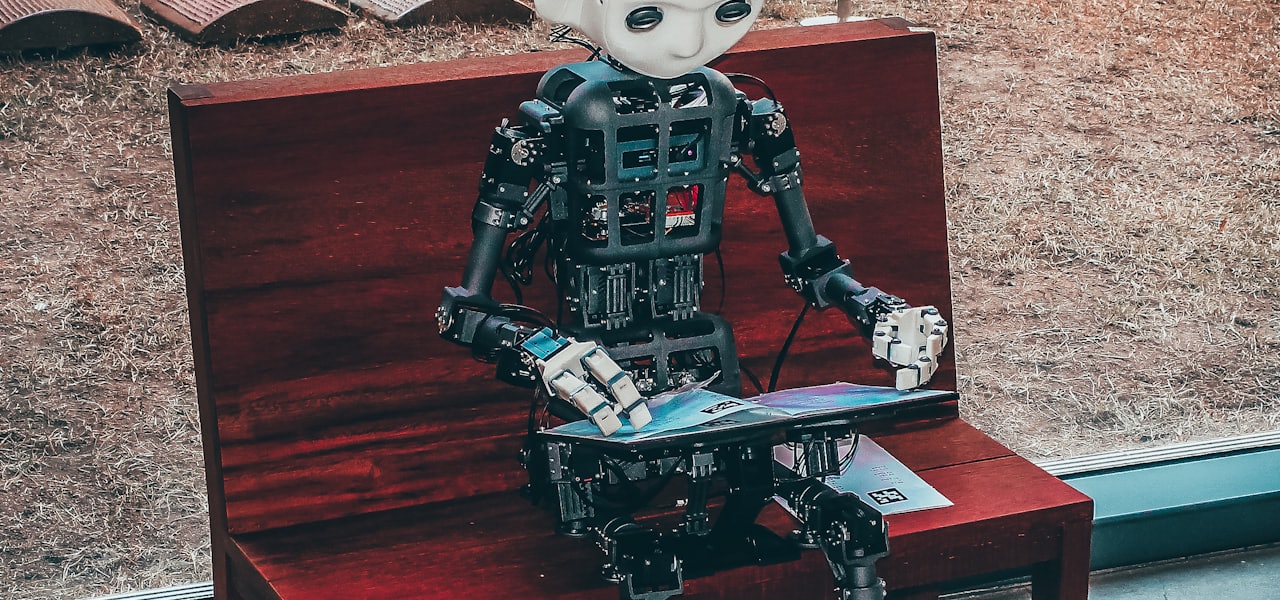
AI: When a Robot Writes a Play (in Czech: AI: Když robot píše hru) is a 2021 experimental theatre play, where 90% of its script was automatically generated by artificial intelligence (the GPT-2 language model). The play is in Czech language, but an English version of the script also exists. == Creation == The play is the first result of the THEaiTRE research project, aiming to commemorate the centenary of the R.U.R. play by Karel Čapek by investigating to what extent artificial intelligence could be used to create theatre play scripts. The script of the play was created using the THEaiTRobot tool, based on the GPT-2 language model. First, the play dramaturge, David Košťák, described the initial setting of each scene in a few sentences, and wrote the first line for each character. Next, THEaiTRobot suggested a continuation of the script, which the dramaturge could use, reject, or use part of it and let the tool generate a new continuation. Another option was to manually insert another line or a scenic remark. The script was generated in English and was automatically translated to Czech by the state-of-the-art CUBBITT machine translation tool. The resulting script was then further post-edited by the dramaturge. The resulting script was made freely available for non-commercial use both in English and in Czech, with marked manually inserted texts and manual edits. The analysis shows that 90% of the English script is automatically generated, with 10% manually written or manually post-edited. In the Czech script, a larger amount of edits were made, but the analysis claims that these additional edits are corrections of errors of the automated translation and stylistic corrections which do not change the meaning of the lines as represented by the English script, but rather bring the Czech script closer to the English one. == Characters == The play contains 9 characters. The Robot appears in all the scenes, while each of the other characters appears in only one scene. Robot – The lead character, a male humanoid robot. Master – An old man, the creator of the Robot. Boy – A schoolboy. Masseuse – A sex worker in a brothel. Stranger – An engineer. Man. Psychologist. Administrator – A female clerk at an employment agency. Actress – A film actress and a model in a robot-like costume. == Plot == The play is composed of 8 scenes. It tells the story of a humanoid robot, who encounters 8 other characters and engages into various typically human situations and activities, related to death, love, sex, violence, etc. The individual scenes are not tightly linked, but there are some linking points, such as the central character of the robot or some repeated and developing themes, such as the robot's search for love. The scenes often contain some absurd turns and it is often hard to find sense in them. It is therefore a very complicated piece interpretationally, requiring the director and the actors to invest a lot of effort and creativity in finding a meaningful interpretation which would not deviate from the script. In the interpretation by Švanda theatre, who premiered the play and who also participated on the creation of the script, the scenes typically contain non-verbally expressed content which can add a lot to the meaning of the scene compared to what is contained in the actual script (as the script only contains the lines said by the characters). === Scene 1: Death === The play opens by the Robot parting with his dying Master. The Master gives the Robot several last lessons and talks with him about death, soul, and love. === Scene 2: Sense of Humour === In the second scene, the Robot meets a sad and angry Boy, who complains that he wants to go to school, that his girlfriend is crazy, that he wants to buy a car, etc. The Robot tries to help the Boy by giving him advice, but the Boy's reactions are quite negative and irritated. The Boy then repeatedly asks the Robot to tell him a joke; the Robot keeps refusing, but ultimately tells the following joke: When you are dead. When your children are dead. When your grandchildren are dead, I will be still alive. === Scene 3: Nightclub === The Robot wants to feel pleasure, so he goes to a "night club" (a brothel), where he meets a "Masseuse" (a prostitute). The Robot is initially "a bit cold", but eventually manages to enjoy the experience and falls in love with the Masseuse. In the Švanda theatre performance, the Robot and the Masseuse seem to have a sort of virtual sex without touching each other, reminiscent of the sex scene in Demolition Man. === Scene 4: Fear of the Dark === It is the night. The Robot is standing under a lamp, unable to move away from the light as he finds that he is afraid of the dark. He meets a Stranger, an engineer who tells him that robots don't have feelings and that people cannot be trusted, and keeps hurting him. In the Švanda theatre performance, the Man repeatedly zaps the Robot with some kind of electric pulse. === Scene 5: Killer Robot === A Man approaches the Robot and repeatedly asks him to kill him. Instead, the Robot sticks a finger into the Man's anus, which leads to an argument between the Man and the Robot. === Scene 6: Burn Out === The Robot meets a Psychologist, who keeps asking him lots of questions regarding his life, burnout feeling, love, relationships, and emotions. They also talk about the Robot using a device called emotion machine which helps him to get rid of stress. === Scene 7: Search for Job === The Robot comes to an employment agency. He meets an Administrator and asks her to help him find a job. He expresses the wish to become an actor, and talks about his experience as a clown. He reveals his name to be Troy McClure, which is a character from The Simpsons who is an actor. In the Švanda theatre performance, the Administrator starts to seduce the Robot once his name is revealed, which he keeps ignoring; the Administrator then becomes irritated. === Scene 8: Love at First Sight === The Robot meets a human Actress in a robotic costume and falls in love with her immediately. The Actress is first reluctant, but the Robot manages to seduce her and she also falls in love with him. The Robot tells her about a binary world, in which he lives and where he will also take her. Ultimately, the Actress agrees, and the whole play concludes by the Robot and the Actress promising each to other to always be together. In the Švanda theatre performance, the Robot does not have a physical body in this scene, we can only hear his voice and see a pulsating light (based on the line in the script where the Robot says: "I have no body. So I don't need to wear clothes. You can't see me, you only hear me."), and the Actress eventually also agrees to lose her physical body so that she can be with the Robot forever. == Theatrical performances == The play premiered on 26 February 2021 in Švanda Theatre in Prague, Czech Republic, directed by Daniel Hrbek. Due to the COVID-19 pandemic, the play was not played in front of a live audience, but it was broadcast online, in Czech language with English subtitles. The play was followed by a panel discussion by the project members and experts on artificial intelligence. The premiere was viewed by 13,498 spectators worldwide. A short trailer of the premiere is available on YouTube. In 2021, after the opening of the theatres in the Czech Republic to spectators, the play can be viewed at Švanda Theatre. The performance takes approximately 60 minutes, and is followed by a discussion of the creators with the audience. The derniere is planned for 4 February 2023. == Reception == The play received a number of reviews, both in its country of origin as well as internationally. It is praised as first of its kind, although some reviewers note the similarity to previous works, such as the musical Beyond the Fence, the play Lifestyle of the Richard and Family, or the short movie Sunspring; however, these works used less advanced technology, and either were very short (Sunspring) or necessitated a larger amount of human interventions. The reviewers note that the script is far from perfect, with many inconsistencies and nonsensical parts, and conclude that the technology is definitely not yet ready to replace human authors; however, some find some parts of the script frighteningly human-like. The amount of human intervention is a somewhat controversial topic, with some reviewers finding the human influence too large (especially in interpreting the script and putting the play on scene), while others feel that a greater amount of human intervention would have been favorable as this could greatly improve the quality of the play. The reviews also frequently comment on the amount of sex, violence and strong language in the play; this can be attributed to the method used for creating the script, where the GPT-2 language model reflects topics and language common in the human-written articles on the internet that were used to train the model. Furthermore, some r
Literature review
A literature review is an overview of previously published works on a particular topic. The term can refer to a full scholarly paper or a section of a scholarly work such as books or articles. Either way, a literature review provides the researcher/author and the audiences with general information of an existing knowledge of a particular topic. A good literature review has a proper research question, a proper theoretical framework, and/or a chosen research method. It serves to situate the current study within the body of the relevant literature and provides context for the reader. In such cases, the review usually precedes the methodology and results sections of the work. Producing a literature review is often part of a graduate and post-graduate requirement, included in the preparation of a thesis, dissertation, or a journal article. Literature reviews are also common in a research proposal or prospectus (the document approved before a student formally begins a dissertation or thesis). A literature review can be a type of a review article. In this sense, it is a scholarly paper that presents the current knowledge including substantive findings as well as theoretical and methodological contributions to a particular topic. Literature reviews are secondary sources and do not report new or original experimental work. Most often associated with academic-oriented literature, such reviews are found in academic journals and are not to be confused with book reviews, which may also appear in the same publication. Literature reviews are a basis for research in nearly every academic field. == Types == Since the concept of a systematic review was formalized in the 1970s, a basic division among types of reviews is the dichotomy of narrative reviews versus systematic reviews. The main types of narrative reviews are evaluative, exploratory, and instrumental. A fourth type of review of literature (the scientific literature) is the systematic review but it is not called a literature review, which absent further specification, conventionally refers to narrative reviews. A systematic review focuses on a specific research question to identify, appraise, select, and synthesize all high-quality research evidence and arguments relevant to that question. A meta-analysis is typically a systematic review using statistical methods to effectively combine the data used on all selected studies to produce a more reliable result. Torraco (2016) describes an integrative literature review. The purpose of an integrative literature review is to generate new knowledge on a topic through the process of review, critique, and synthesis of the literature under investigation. George et al (2023) offer an extensive overview of review approaches. They also propose a model for selecting an approach by looking at the purpose, object, subject, community, and practices of the review. They describe six different types of review, each with their own unique purposes: Exploratory or scoping reviews focus on breadth as opposed to depth Systematic or integrative reviews integrate empirical studies on a topic Meta-narrative reviews are qualitative and use literature to compare research or practice communities Problematizing or critical reviews propose new perspectives on a concept by association with other literature Meta-analyses and meta-regressions integrate quantitative studies and identify moderators Mixed research syntheses combine other review approaches in the same paper == Process and product == Shields and Rangarajan (2013) distinguish between the process of reviewing the literature and a finished work or product known as a literature review. The process of reviewing the literature is often ongoing and informs many aspects of the empirical research project. The process of reviewing the literature requires different kinds of activities and ways of thinking. Shields and Rangarajan (2013) and Granello (2001) link the activities of doing a literature review with Benjamin Bloom's revised taxonomy of the cognitive domain (ways of thinking: remembering, understanding, applying, analyzing, evaluating, and creating). === Use of artificial intelligence in a literature review === Artificial intelligence (AI) is reshaping traditional literature reviews across various disciplines. Generative pre-trained transformers, such as ChatGPT, are often used by students and academics for review purposes. Since 2023, an increasing number of tools powered by large language models and other artificial intelligence technologies have been developed to assist, automate, or generate literature reviews. Nevertheless, the employment of ChatGPT in academic reviews is problematic due to ChatGPT's propensity to "hallucinate". In response, efforts are being made to mitigate these hallucinations through the integration of plugins. For instance, Rad et al. (2023) used ScholarAI for review in cardiothoracic surgery.
Data access layer
A data access layer (DAL) is a software architectural layer that provides access to data from one or more sources, such as a relational database, NoSQL database, SQL query engine, file system, or other persistent storage. It separates client code from the details of storage systems, query execution, connection handling, and data retrieval. Data access layers are commonly used to centralize data access logic, reduce coupling between applications and data sources, and provide a consistent interface for retrieving, writing, or querying data. Depending on the system, a data access layer may be implemented as application code, a shared library, an intermediary service, or part of a broader database abstraction layer. == In application architecture == In application software, a data access layer provides a boundary between business logic or application code and the systems used to store or retrieve data. For example, a data access layer may expose methods or interfaces for retrieving, writing, or querying data while hiding details such as connection management, SQL statements, storage APIs, error handling, and result conversion. Depending on the application, the layer may return objects, records, tabular results, documents, streams, or other representations of data. A common implementation is a set of classes, functions, or methods that directly reference database queries, stored procedures, storage APIs, or other data sources. For example, instead of using commands such as insert, delete, and update throughout an application to access a specific table, methods such as registerUser or loginUser may be implemented inside the data access layer. Business logic methods from an application can also be mapped to the data access layer. Instead of making several database queries directly, an application can call a single DAL method that abstracts those database calls. Applications using a data access layer may be either dependent on or independent from a particular database server. If the data access layer supports multiple database systems, the application can use any database system that the DAL can access. In either case, the data access layer provides a centralized location for calls into the underlying data store, which can make it easier to maintain, test, or port the application to other storage systems. == Implementation patterns == A data access layer can be implemented using several patterns and technologies, including data access objects, repositories, stored procedures, query builders, database drivers, or object–relational mapping tools. These mechanisms may implement part or all of a data access layer, but are not always equivalent to the layer itself. Object–relational mapping tools are commonly used in data access layers for object-oriented applications that map records in a relational database to objects in a programming language. Other data access layers may expose lower-level database interfaces, tabular results, document-oriented data, files, streams, or protocol-level interfaces. == Use with multiple underlying data systems == A data access layer may be used to abstract differences between multiple underlying data systems, allowing applications to access them through a more consistent interface. In such designs, applications call the DAL rather than interacting directly with each database or storage system. The layer may then handle connection management, query generation, result mapping, error handling, and other implementation details. A data access layer may be implemented as a shared library or as an intermediary service, such as a proxy or gateway. In this configuration, client applications or services connect to the data access layer, which then communicates with one or more underlying databases or query engines. This can provide a common location for authentication, authorization, logging, routing, and translation between different database interfaces. == Interfaces and protocols == Data access layers may expose or use standardized interfaces and protocols for database access. Examples include Open Database Connectivity (ODBC), Java Database Connectivity (JDBC), database-native wire protocols, and newer interfaces such as Apache Arrow Database Connectivity (ADBC) and Arrow Flight SQL. In systems that support multiple data stores, a data access layer may provide a consistent interface while using different drivers, protocols, or query mechanisms internally. == Distinction from related patterns == A data access layer is related to, but broader than, a data access object, which is usually an object-oriented design pattern for encapsulating access to a persistence mechanism. It is also related to a database abstraction layer, which focuses on hiding differences between database systems. In practice, the terms may overlap.
Wearable computer
A wearable computer, also known as a body-borne computer or wearable, is a computing device worn on the body. The definition of 'wearable computer' may be narrow or broad, extending to smartphones or even ordinary wristwatches. Wearables may be for general use, in which case they are just a particularly small example of mobile computing. Alternatively, they may be for specialized purposes such as fitness trackers. They may incorporate special sensors such as accelerometers, heart rate monitors, or on the more advanced side, electrocardiogram (ECG) and blood oxygen saturation (SpO2) monitors. Under the definition of wearable computers, we also include novel user interfaces such as Google Glass, an optical head-mounted display controlled by gestures. It may be that specialized wearables will evolve into general all-in-one devices, as happened with the convergence of PDAs and mobile phones into smartphones. Wearables are typically worn on the wrist (e.g. fitness trackers), hung from the neck (like a necklace), strapped to the arm or leg (electronic tagging), or on the head (as glasses or a helmet), though some have been located elsewhere (e.g. on a finger or in a shoe). Devices carried in a pocket or bag – such as smartphones and before them, pocket calculators and PDAs, may or may not be regarded as 'worn'. Wearable computers have various technical issues common to other mobile computing, such as batteries, heat dissipation, software architectures, wireless and personal area networks, and data management. Many wearable computers are active all the time, e.g. processing or recording data continuously. == Applications == Wearable computers are not only limited to computers such as fitness trackers that are worn on wrists; they also include wearables such as heart pacemakers and other prosthetics. They are used most often in research that focuses on behavioral modeling, health monitoring systems, IT and media development, where the person wearing the computer actually moves or is otherwise engaged with his or her surroundings. Wearable computers have been used for the following: general-purpose computing (e.g. smartphones and smartwatches) sensory integration, e.g. to help people see better or understand the world better (whether in task-specific applications like camera-based welding helmets or for everyday use like Google Glass) behavioral modeling health care monitoring systems service management electronic textiles and fashion design, e.g. Microsoft's 2011 prototype "The Printing Dress". Wearable computing is the subject of active research, especially the form-factor and location on the body, with areas of study including user interface design, augmented reality, and pattern recognition. The use of wearables for specific applications, for compensating disabilities or supporting elderly people steadily increases. == Operating systems == The dominant operating systems for wearable computing are: FreeRTOS is a real-time operating system kernel for embedded devices; most of the Smartbands that are currently available in the market are based on FreeRTOS, which include Huawei, Honor, Lenovo, realme, TCL and Xiaomi smartbands. LiteOS is a lightweight open source real-time operating system that is part of Huawei's "1+8+N" Internet of Things solution. Tizen OS from Samsung (there was an announcement in May 2021 that Wear OS and Tizen OS will merge and will be called simply Wear.) watchOS watchOS is a proprietary mobile operating system developed by Apple Inc. to run on the Apple Watch. Wear OS Wear OS (previously known as Android Wear) is a smartwatch operating system developed by Google Inc. == History == Due to the varied definitions of wearable and computer, the first wearable computer could be as early as the first abacus on a necklace, a 16th-century abacus ring, a wristwatch and 'finger-watch' owned by Queen Elizabeth I of England, or the covert timing devices hidden in shoes to cheat at roulette by Thorp and Shannon in the 1960s and 1970s. However, a general-purpose computer is not merely a time-keeping or calculating device, but rather a user-programmable item for arbitrary complex algorithms, interfacing, and data management. By this definition, the wearable computer was invented by Steve Mann, in the late 1970s: Steve Mann, a professor at the University of Toronto, was hailed as the father of the wearable computer and the ISSCC's first virtual panelist, by moderator Woodward Yang of Harvard University (Cambridge Mass.). The development of wearable items has taken several steps of miniaturization from discrete electronics over hybrid designs to fully integrated designs, where just one processor chip, a battery, and some interface conditioning items make the whole unit. === 1500s === Queen Elizabeth I of England received a watch from Robert Dudley in 1571, as a New Year's present; it may have been worn on the forearm rather than the wrist. She also possessed a 'finger-watch' set in a ring, with an alarm that prodded her finger. === 1600s === The Qing dynasty saw the introduction of a fully functional abacus on a ring, which could be used while it was being worn. === 1960s === In 1961, mathematicians Edward O. Thorp and Claude Shannon built some computerized timing devices to help them win a game of roulette. One such timer was concealed in a shoe and another in a pack of cigarettes. Various versions of this apparatus were built in the 1960s and 1970s. Thorp refers to himself as the inventor of the first "wearable computer". In other variations, the system was a concealed cigarette-pack-sized analog computer designed to predict the motion of roulette wheels. A data-taker would use microswitches hidden in his shoes to indicate the speed of the roulette wheel, and the computer would indicate an octant of the roulette wheel to bet on by sending musical tones via radio to a miniature speaker hidden in a collaborator's ear canal. The system was successfully tested in Las Vegas in June 1961, but hardware issues with the speaker wires prevented it from being used beyond test runs. This was not a wearable computer because it could not be re-purposed during use; rather it was an example of task-specific hardware. This work was kept secret until it was first mentioned in Thorp's book Beat the Dealer (revised ed.) in 1966 and later published in detail in 1969. === 1970s === Pocket calculators became mass-market devices in 1970, starting in Japan. Programmable calculators followed in the late 1970s, being somewhat more general-purpose computers. The HP-01 algebraic calculator watch by Hewlett-Packard was released in 1977. A camera-to-tactile vest for the blind, launched by C.C. Collins in 1977, converted images into a 1024-point, ten-inch square tactile grid on a vest. === 1980s === The 1980s saw the rise of more general-purpose wearable computers. In 1981, Steve Mann designed and built a backpack-mounted 6502-based wearable multimedia computer with text, graphics, and multimedia capability, as well as video capability (cameras and other photographic systems). Mann went on to be an early and active researcher in the wearables field, especially known for his 1994 creation of the Wearable Wireless Webcam, the first example of lifelogging. Seiko Epson released the RC-20 Wrist Computer in 1984. It was an early smartwatch, powered by a computer on a chip. In 1989, Reflection Technology marketed the Private Eye head-mounted display, which scans a vertical array of LEDs across the visual field using a vibrating mirror. This display gave rise to several hobbyist and research wearables, including Gerald "Chip" Maguire's IBM/Columbia University Student Electronic Notebook, Doug Platt's Hip-PC, and Carnegie Mellon University's VuMan 1 in 1991. The Student Electronic Notebook consisted of the Private Eye, Toshiba diskless AIX notebook computers (prototypes), a stylus based input system and a virtual keyboard. It used direct-sequence spread spectrum radio links to provide all the usual TCP/IP based services, including NFS mounted file systems and X11, which all ran in the Andrew Project environment. The Hip-PC included an Agenda palmtop used as a chording keyboard attached to the belt and a 1.44 megabyte floppy drive. Later versions incorporated additional equipment from Park Engineering. The system debuted at "The Lap and Palmtop Expo" on 16 April 1991. VuMan 1 was developed as part of a Summer-term course at Carnegie Mellon's Engineering Design Research Center, and was intended for viewing house blueprints. Input was through a three-button unit worn on the belt, and output was through Reflection Tech's Private Eye. The CPU was an 8 MHz 80188 processor with 0.5 MB ROM. === 1990s === In the 1990s PDAs became widely used, and in 1999 were combined with mobile phones in Japan to produce the first mass-market smartphone. In 1993, the Private Eye was used in Thad Starner's wearable, based on Doug Platt's system and built from a kit from Park Enterprises, a Pri