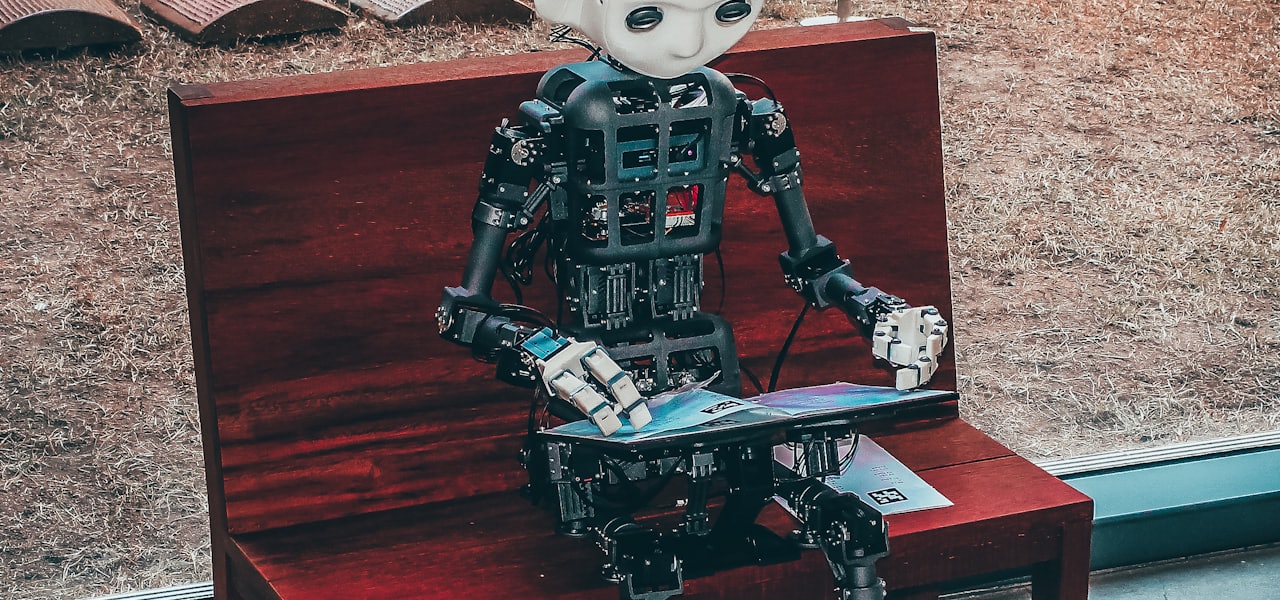
Artificial intelligence in education (often abbreviated as AIEd) is a subfield of educational technology that studies how to use artificial intelligence to create learning environments. Considerations in the field include data-driven decision-making, AI ethics, data privacy and AI literacy. Concerns include the potential for cheating, over-reliance, equity of access, reduced critical thinking, and the perpetuation of misinformation and bias. == History == Efforts to integrate AI into educational contexts have often followed technological advancement in the history of artificial intelligence. In the 1960s, educators and researchers began developing computer-based instruction systems, such as PLATO, developed by the University of Illinois. In the 1970s and 1980s, intelligent tutoring systems (ITS) were being adapted for classroom instruction. The International Artificial Intelligence in Education Society was founded in 1993. Coinciding with the AI boom of the 2020s, the use of large language models in the global north has been promoted and funded by venture capital and big tech. Companies creating AI services have targeted students and educational institutions as customers. Similarly, pre-AI boom educational companies have expanded their use of AI technologies. These commercial incentives for AIEd use may be related to a potential AI bubble. In the U.S., bipartisan support of AI development in K-12 education has been expressed, but specific implementations and best practices remain contentious. == Theory == AIEd applies theory from education studies, machine learning, and related fields. A 2019 review of the previous decade of studies found that most research prioritized technological design over pedagogical integration. Ouyang and Jiao (2021) propose three paradigms for AI in education, which follow roughly from least to most learner-centered and from requiring least to most technical complexity from the AI systems: AI-directed, learner-as-recipient: AIEd systems present a pre-set curriculum based on statistical patterns that do not adjust to learner's feedback. AI-supported, learner-as-collaborator: Systems that incorporate responsiveness to learner's feedback through, for example, natural language processing, wherein AI can support knowledge construction. AI-empowered, learner-as-leader: This model seeks to position AI as a supplement to human intelligence wherein learners take agency and AI provides consistent and actionable feedback. Some scholars place AI in education within a socio-technical framework. This positions AI alongside other emerging educational technologies, such as computing, the internet, and social media. The framework of Tsao, Heinrichs and Camit (2025) draws on new materialism and posthumanism, specifically Donna Haraway's concept of sympoiesis (making-with). This perspective views learning as an entanglement of human and non-human actors (students, teachers, and AI algorithms), where knowledge is co-composed in contact zones between human context and algorithmic prediction. AI agents have been trained on biased datasets, and thus continue to perpetuate societal biases. Since LLMs were created to produce human-like text, algorithmic bias can be introduced and reproduced. AI's data processing and monitoring reinforce neoliberal approaches to education rather than addressing inequalities. == Applications == Uses of generative AI chatbots in education have included assessment and feedback, machine translations, proof-reading exam question generation and copy editing, or as virtual assistants. Emotional AI in education is the study and development of systems that can detect learners' emotions or provide emotional support in learning. == Usage == === Schools and educators === Following the release of ChatGPT in November 2022, some schools and large school districts blocked access to the site and issued warnings that the use of such tools would be seen as cheating. Governmental and non-governmental organizations such as UNESCO, Article 4 of the European Union's AI Act, and the U.S. Department of Education have published reports advocating for specific AIEd approaches. National higher-education bodies have also published guidance on generative AI, including Ireland's Higher Education Authority, which issued a policy framework for higher education teaching and learning in December 2025. In 2024, UNESCO released updated global guidance for generative AI in education, emphasizing ethical use, teacher training, and data protection to ensure responsible integration of AI tools in learning environments. According to Taso (2025), policy implementation in higher education is interpreted and enacted differently by various organizations. These decentralized policies can lead to inconsistent enforcement and confusion among students regarding what constitutes acceptable use, with the burden of ethical navigation falling on individual teachers and students. AI integration in classrooms has created new forms of invisible labour for educators, who must navigate ambiguous policies, redesign assessments to be AI-resilient, and adjudicate potential academic integrity violations. The use of AI detection tools has also been criticised for creating an adversarial relationship between students and institutions, where students may be falsely accused of misconduct based on probabilistic software. AIEd advocates say that efforts should be made towards increasing global accessibility and training educators to serve underprivileged areas. === Students === Reliance on generative AI has been linked with reduced academic self-esteem and performance, and heightened learned helplessness. Algorithm errors and hallucinations are common flaws in AI agents, making them less trustworthy and reliable. According to a 2025 survey from Inside Higher Ed, 85% of higher education students use generative AI technology in some way, with 25% using AI to complete assignments for them. The most common reason cited for using AI to cheat was pressure to get high grades. 97% of students wanted some form of action from schools on the threat to academic integrity caused by AI, with the most popular options being clearer policies and more education about ethical uses of AI. In September 2025, The Atlantic published an op-ed from a high school senior arguing that the normalization of AI cheating was eroding critical thinking, academic integrity, creativity, and the shared student experience.
Speech segmentation
Speech segmentation is the process of identifying the boundaries between words, syllables, or phonemes in spoken natural languages. The term applies both to the mental processes used by humans, and to artificial processes of natural language processing. In the field of automatic pronunciation assessment, the process of segmenting an utterance against expected word(s) is called forced alignment. Speech segmentation is a subfield of general speech perception and an important subproblem of the technologically focused field of speech recognition, and cannot be adequately solved in isolation. As in most natural language processing problems, one must take into account context, grammar, and semantics, and even so the result is often a probabilistic division (statistically based on likelihood) rather than a categorical one. Though it seems that coarticulation—a phenomenon which may happen between adjacent words just as easily as within a single word—presents the main challenge in speech segmentation across languages, some other problems and strategies employed in solving those problems can be seen in the following sections. This problem overlaps to some extent with the problem of text segmentation that occurs in some languages which are traditionally written without inter-word spaces, like Chinese and Japanese, compared to writing systems which indicate speech segmentation between words by a word divider, such as the space. However, even for those languages, text segmentation is often much easier than speech segmentation, because the written language usually has little interference between adjacent words, and often contains additional clues not present in speech (such as the use of Chinese characters for word stems in Japanese). == Lexical recognition == In natural languages, the meaning of a complex spoken sentence can be understood by decomposing it into smaller lexical segments (roughly, the words of the language), associating a meaning to each segment, and combining those meanings according to the grammar rules of the language. Though lexical recognition is not thought to be used by infants in their first year, due to their highly limited vocabularies, it is one of the major processes involved in speech segmentation for adults. Three main models of lexical recognition exist in current research: first, whole-word access, which argues that words have a whole-word representation in the lexicon; second, decomposition, which argues that morphologically complex words are broken down into their morphemes (roots, stems, inflections, etc.) and then interpreted and; third, the view that whole-word and decomposition models are both used, but that the whole-word model provides some computational advantages and is therefore dominant in lexical recognition. To give an example, in a whole-word model, the word "cats" might be stored and searched for by letter, first "c", then "ca", "cat", and finally "cats". The same word, in a decompositional model, would likely be stored under the root word "cat" and could be searched for after removing the "s" suffix. "Falling", similarly, would be stored as "fall" and suffixed with the "ing" inflection. Though proponents of the decompositional model recognize that a morpheme-by-morpheme analysis may require significantly more computation, they argue that the unpacking of morphological information is necessary for other processes (such as syntactic structure) which may occur parallel to lexical searches. As a whole, research into systems of human lexical recognition is limited due to little experimental evidence that fully discriminates between the three main models. In any case, lexical recognition likely contributes significantly to speech segmentation through the contextual clues it provides, given that it is a heavily probabilistic system—based on the statistical likelihood of certain words or constituents occurring together. For example, one can imagine a situation where a person might say "I bought my dog at a ____ shop" and the missing word's vowel is pronounced as in "net", "sweat", or "pet". While the probability of "netshop" is extremely low, since "netshop" isn't currently a compound or phrase in English, and "sweatshop" also seems contextually improbable, "pet shop" is a good fit because it is a common phrase and is also related to the word "dog". Moreover, an utterance can have different meanings depending on how it is split into words. A popular example, often quoted in the field, is the phrase "How to wreck a nice beach", which sounds very similar to "How to recognize speech". As this example shows, proper lexical segmentation depends on context and semantics which draws on the whole of human knowledge and experience, and would thus require advanced pattern recognition and artificial intelligence technologies to be implemented on a computer. Lexical recognition is of particular value in the field of computer speech recognition, since the ability to build and search a network of semantically connected ideas would greatly increase the effectiveness of speech-recognition software. Statistical models can be used to segment and align recorded speech to words or phones. Applications include automatic lip-synch timing for cartoon animation, follow-the-bouncing-ball video sub-titling, and linguistic research. Automatic segmentation and alignment software is commercially available. == Phonotactic cues == For most spoken languages, the boundaries between lexical units are difficult to identify; phonotactics are one answer to this issue. One might expect that the inter-word spaces used by many written languages like English or Spanish would correspond to pauses in their spoken version, but that is true only in very slow speech, when the speaker deliberately inserts those pauses. In normal speech, one typically finds many consecutive words being said with no pauses between them, and often the final sounds of one word blend smoothly or fuse with the initial sounds of the next word. The notion that speech is produced like writing, as a sequence of distinct vowels and consonants, may be a relic of alphabetic heritage for some language communities. In fact, the way vowels are produced depends on the surrounding consonants just as consonants are affected by surrounding vowels; this is called coarticulation. For example, in the word "kit", the [k] is farther forward than when we say 'caught'. But also, the vowel in "kick" is phonetically different from the vowel in "kit", though we normally do not hear this. In addition, there are language-specific changes which occur in casual speech which makes it quite different from spelling. For example, in English, the phrase "hit you" could often be more appropriately spelled "hitcha". From a decompositional perspective, in many cases, phonotactics play a part in letting speakers know where to draw word boundaries. In English, the word "strawberry" is perceived by speakers as consisting (phonetically) of two parts: "straw" and "berry". Other interpretations such as "stra" and "wberry" are inhibited by English phonotactics, which does not allow the cluster "wb" word-initially. Other such examples are "day/dream" and "mile/stone" which are unlikely to be interpreted as "da/ydream" or "mil/estone" due to the phonotactic probability or improbability of certain clusters. The sentence "Five women left", which could be phonetically transcribed as [faɪvwɪmɘnlɛft], is marked since neither /vw/ in /faɪvwɪmɘn/ nor /nl/ in /wɪmɘnlɛft/ are allowed as syllable onsets or codas in English phonotactics. These phonotactic cues often allow speakers to easily distinguish the boundaries in words. Vowel harmony in languages like Finnish can also serve to provide phonotactic cues. While the system does not allow front vowels and back vowels to exist together within one morpheme, compounds allow two morphemes to maintain their own vowel harmony while coexisting in a word. Therefore, in compounds such as "selkä/ongelma" ('back problem') where vowel harmony is distinct between two constituents in a compound, the boundary will be wherever the switch in harmony takes place—between the "ä" and the "ö" in this case. Still, there are instances where phonotactics may not aid in segmentation. Words with unclear clusters or uncontrasted vowel harmony as in "opinto/uudistus" ('student reform') do not offer phonotactic clues as to how they are segmented. From the perspective of the whole-word model, however, these words are thought be stored as full words, so the constituent parts would not necessarily be relevant to lexical recognition. == In infants and non-natives == Infants are one major focus of research in speech segmentation. Since infants have not yet acquired a lexicon capable of providing extensive contextual clues or probability-based word searches within their first year, as mentioned above, they must often rely primarily upon phonotactic and rhythmic cues (with prosody being the dominant cue), all
Information Processing Language
Information Processing Language (IPL) is a programming language created by Allen Newell, Cliff Shaw, and Herbert A. Simon at RAND Corporation and the Carnegie Institute of Technology about 1956. Newell had the job of language specifier-application programmer, Shaw was the system programmer, and Simon had the job of application programmer-user. IPL included features to facilitate AI programming, specifically problem solving. such as lists, dynamic memory allocation, data types, recursion, functions as arguments, generators, and cooperative multitasking. IPL also introduced the concepts of symbol processing and list processing. Unfortunately, all of these innovations were cast in a difficult assembly-language style. Nonetheless, IPL-V (the only public version of IPL) ran on many computers through the mid 1960s. == Basics of IPL == An IPL computer has: A set of symbols. All symbols are addresses, and name cells. Unlike symbols in later languages, symbols consist of a character followed by a number, and are written H1, A29, 9–7, 9–100. Cell names beginning with a letter are regional, and are absolute addresses. Cell names beginning with "9-" are local, and are meaningful within the context of a single list. One list's 9-1 is independent of another list's 9–1. Other symbols (e.g., pure numbers) are internal. A set of cells. Lists are made from several cells including mutual references. Cells have several fields: P, a 3-bit field used for an operation code when the cell is used as an instruction, and unused when the cell is data. Q, a 3-valued field used for indirect reference when the cell is used as an instruction, and unused when the cell is data. SYMB, a symbol used as the value in the cell. A set of primitive processes, which would be termed primitive functions in modern languages. The data structure of IPL is the list, but lists are more intricate structures than in many languages. A list consists of a singly linked sequence of symbols, as might be expected—plus some description lists, which are subsidiary singly linked lists interpreted as alternating attribute names and values. IPL provides primitives to access and mutate attribute value by name. The description lists are given local names (of the form 9–1). So, a list named L1 containing the symbols S4 and S5, and described by associating value V1 to attribute A1 and V2 to A2, would be stored as follows. 0 indicates the end of a list; the cell names 100, 101, etc. are automatically generated internal symbols whose values are irrelevant. These cells can be scattered throughout memory; only L1, which uses a regional name that must be globally known, needs to reside in a specific place. IPL is an assembly language for manipulating lists. It has a few cells which are used as special-purpose registers. H1, for example, is the program counter. The SYMB field of H1 is the name of the current instruction. However, H1 is interpreted as a list; the LINK of H1 is, in modern terms, a pointer to the beginning of the call stack. For example, subroutine calls push the SYMB of H1 onto this stack. H2 is the free-list. Procedures which need to allocate memory grab cells off of H2; procedures which are finished with memory put it on H2. On entry to a function, the list of parameters is given in H0; on exit, the results should be returned in H0. Many procedures return a Boolean result indicating success or failure, which is put in H5. Ten cells, W0-W9, are reserved for public working storage. Procedures are "morally bound" (to quote the CACM article) to save and restore the values of these cells. There are eight instructions, based on the values of P: subroutine call, push/pop S to H0; push/pop the symbol in S to the list attached to S; copy value to S; conditional branch. In these instructions, S is the target. S is either the value of the SYMB field if Q=0, the symbol in the cell named by SYMB if Q=1, or the symbol in the cell named by the symbol in the cell named by SYMB if Q=2. In all cases but conditional branch, the LINK field of the cell tells which instruction to execute next. IPL has a library of some 150 basic operations. These include such operations as: Test symbols for equality Find, set, or erase an attribute of a list Locate the next symbol in a list; insert a symbol in a list; erase or copy an entire list Arithmetic operations (on symbol names) Manipulation of symbols; e.g., test if a symbol denotes an integer, or make a symbol local I/O operations "Generators", which correspond to iterators and filters in functional programming. For example, a generator may accept a list of numbers and produce the list of their squares. Generators could accept suitably designed functions—strictly, the addresses of code of suitably designed functions—as arguments. == History == IPL was first utilized to demonstrate that the theorems in Principia Mathematica which were proven laboriously by hand, by Bertrand Russell and Alfred North Whitehead, could in fact be proven by computation. According to Simon's autobiography Models of My Life, this application was originally developed first by hand simulation, using his children as the computing elements, while writing on and holding up note cards as the registers which contained the state variables of the program. IPL was used to implement several early artificial intelligence programs, also by the same authors: the Logic Theorist (1956), the General Problem Solver (1957), and their computer chess program NSS (1958). Several versions of IPL were created: IPL-I (never implemented), IPL-II (1957 for JOHNNIAC), IPL-III (existed briefly), IPL-IV, IPL-V (1958, for IBM 650, IBM 704, IBM 7090, Philco model 212, many others. Widely used). IPL-VI was a proposal for an IPL hardware. A co-processor “IPL-VC” for the CDC 3600 at Argonne National Libraries was developed which could run IPL-V commands. It was used to implement another checker-playing program. This hardware implementation did not improve running times sufficiently to “compete favorably with a language more directly oriented to the structure of present-day machines”. IPL was soon displaced by Lisp, which had much more powerful features, a simpler syntax, and the benefit of automatic garbage collection. == Legacy to computer programming == IPL arguably introduced several programming language features: List manipulation—but only lists of atoms, not general lists Property lists—but only when attached to other lists Higher-order functions—while assembly programming had always allowed computing with the addresses of functions, IPL was an early attempt to generalize this property of assembly language in a principled way Computation with symbols—though symbols have a restricted form in IPL (letter followed by number) Virtual machine Many of these features were generalized, rationalized, and incorporated into Lisp and from there into many other programming languages during the next several decades.
DeepSeek
Hangzhou DeepSeek Artificial Intelligence Basic Technology Research Co., Ltd., doing business as DeepSeek, is a Chinese artificial intelligence (AI) company that develops large language models (LLMs). Based in Hangzhou, Zhejiang, DeepSeek is owned and funded by High-Flyer, a Chinese hedge fund. DeepSeek was founded in July 2023 by Liang Wenfeng, the co-founder of High-Flyer, who also serves as the CEO for both of the companies. The company launched an eponymous chatbot alongside its DeepSeek-R1 model in January 2025. DeepSeek-R1 provided responses comparable to other contemporary large language models, such as OpenAI's GPT-4 and o1. Its training cost was reported to be significantly lower than other LLMs. The company claims that it trained its V3 model for US$6 million—far less than the US$100 million cost for OpenAI's GPT-4 in 2023—and using approximately one-tenth the computing power consumed by Meta's comparable model, Llama 3.1. DeepSeek's success against larger and more established rivals has been described as "upending AI". DeepSeek's models are described as "open-weight", meaning the exact parameters are openly shared, but the training data is not openly licensed. Since the January 2025 debut of DeepSeek-R1, the company has made its new models available under free and open-source software licenses, primarily the MIT License. The company reportedly recruits AI researchers from top Chinese universities and also hires from outside traditional computer science fields to broaden its models' knowledge and capabilities. DeepSeek significantly reduced training expenses for their R1 model by incorporating techniques such as mixture of experts (MoE) layers. The company also trained its models during ongoing trade restrictions on AI chip exports to China, using weaker AI chips intended for export and employing fewer units overall. Observers say this breakthrough sent "shock waves" through the industry which were described as triggering a "Sputnik moment" for the US in the field of artificial intelligence, particularly due to its open-source, cost-effective, and high-performing AI models. This threatened established AI hardware leaders such as Nvidia; Nvidia's share price dropped sharply, losing US$600 billion in market value, the largest single-company decline in U.S. stock market history. == History == === Founding and early years (2016–2023) === In February 2016, High-Flyer was co-founded by AI enthusiast Liang Wenfeng, who had been trading since the 2008 financial crisis while attending Zhejiang University. The company began stock trading using a GPU-dependent deep learning model on 21 October 2016; before then, it had used CPU-based linear models. By the end of 2017, most of its trading was driven by AI. Liang established High-Flyer as a hedge fund focused on developing and using AI trading algorithms, and by 2021 the firm was using AI exclusively, often using Nvidia chips. In 2019, the company began constructing its first computing cluster, Fire-Flyer, at a cost of 200 million yuan; it contained 1,100 GPUs interconnected at 200 Gbit/s and was retired after 1.5 years in operation. By 2021, Liang had started buying large quantities of Nvidia GPUs for an AI project, reportedly obtaining 10,000 Nvidia A100 GPUs before the United States restricted chip sales to China. Computing cluster Fire-Flyer 2 began construction in 2021 with a budget of 1 billion yuan. It was reported that in 2022, Fire-Flyer 2's capacity had been used at over 96%, totaling 56.74 million GPU hours. 27% was used to support scientific computing outside the company. During 2022, Fire-Flyer 2 had 5,000 PCIe A100 GPUs in 625 nodes, each containing 8 GPUs. At the time, it exclusively used PCIe instead of the DGX version of A100, since at the time the models it trained could fit within a single 40 GB GPU VRAM and so there was no need for the higher bandwidth of DGX (i.e., it required only data parallelism but not model parallelism). Later, it incorporated NVLinks and NCCL (Nvidia Collective Communications Library) to train larger models that required model parallelism. On 14 April 2023, High-Flyer announced the launch of an artificial general intelligence (AGI) research lab, stating that the new lab would focus on developing AI tools unrelated to the firm's financial business. Two months later, on 17 July 2023, that lab was spun off into an independent company, DeepSeek, with High-Flyer as its principal investor and backer. Venture capital investors were reluctant to provide funding, as they considered it unlikely that the venture would be able to quickly generate an "exit". === Model releases since 2023 === DeepSeek released its first model, DeepSeek Coder, on 2 November 2023, followed by the DeepSeek-LLM series on 29 November 2023. In January 2024, it released two DeepSeek-MoE models (Base and Chat), and in April 3 DeepSeek-Math models (Base, Instruct, and RL). DeepSeek-V2 was released in May 2024, followed a month later by the DeepSeek-Coder V2 series. In September 2024, DeepSeek V2.5 was introduced and revised in December. On 20 November 2024, the preview of DeepSeek-R1-Lite became available via chat. In December, DeepSeek-V3-Base and DeepSeek-V3 (chat) were released. On 20 January 2025, DeepSeek launched the DeepSeek chatbot—based on the DeepSeek-R1 model—free for iOS and Android. By 27 January, DeepSeek surpassed ChatGPT as the most downloaded freeware app on the iOS App Store in the United States, triggering an 18% drop in Nvidia's share price. On 24 March 2025, DeepSeek released DeepSeek-V3-0324 under the MIT License. On 28 May 2025, DeepSeek released DeepSeek-R1-0528 under the MIT License. The model has been noted for more tightly following official Chinese Communist Party ideology and censorship in its answers to questions than prior models. On 21 August 2025, DeepSeek released DeepSeek V3.1 under the MIT License. This model features a hybrid architecture with thinking and non-thinking modes. It also surpasses prior models like V3 and R1, by over 40% on certain benchmarks like SWE-bench and Terminal-bench. It was updated to V3.1-Terminus on 22 September 2025. V3.2-Exp was released on 29 September 2025. It uses DeepSeek Sparse Attention, a more efficient attention mechanism based on previous research published in February. DeepSeek-V3.2 was released on 1 December 2025, alongside a DeepSeek-V3.2-Speciale variant that focused on reasoning. In February 2026, Anthropic accused DeepSeek of using thousands of fraudulent accounts to generate millions of conversations with Claude to train its own large language models. In April 2026, investors began speaking with DeepSeek for a $300 million funding round, which would bring DeepSeek to a total valuation of $10 billion. On April 24, 2026, DeepSeek released a preview of its V4 series, including the 1.6-trillion parameter DeepSeek-V4-Pro and the 284-billion parameter DeepSeek-V4-Flash, both featuring a 1-million token context window, under the MIT License. DeepSeek's V4 LLM has been adopted by key semiconductor manufacturers and artificial intelligence chipmakers such as Huawei and Cambricon. == Company operation == DeepSeek is headquartered in Hangzhou, Zhejiang, and is owned and funded by High-Flyer. Its co-founder, Liang Wenfeng, serves as CEO. As of May 2024, Liang personally held an 84% stake in DeepSeek through two shell corporations. === Strategy === DeepSeek has stated that it focuses on research and does not have immediate plans for commercialization. This posture also means it can skirt certain provisions of China's AI regulations aimed at consumer-facing technologies. DeepSeek's hiring approach emphasizes skills over lengthy work experience, resulting in many hires fresh out of university. The company likewise recruits individuals without computer science backgrounds to expand the range of expertise incorporated into the models, for instance in poetry or advanced mathematics. According to The New York Times, dozens of DeepSeek researchers have or have previously had affiliations with People's Liberation Army laboratories and the Seven Sons of National Defence. Due to the impact of United States restrictions on chips, DeepSeek refined its algorithms to maximise computational efficiency and thereby leveraged older hardware and reduced energy consumption. DeepSeek also expanded on the African continent as it offers more affordable and less power-hungry AI solutions. The company has bolstered African language models and generated a number of startups, for example in Nairobi. Along with Huawei's storage and cloud computing services, the impact on the tech scene in sub-saharan Africa is considerable. DeepSeek offers local data sovereignty and more flexibility compared to Western AI platforms. == Training framework == High-Flyer/DeepSeek had operated at least two primary computing clusters: Fire-Flyer (萤火一号) and Fire-Flyer 2 (萤火二号). Fire-Flyer 1 was constructed in 2019 and was retired after 1.5 years of operation. Fi
Meta Content Framework
Meta Content Framework (MCF) is a specification of a content format for structuring metadata about web sites and other data. == History == MCF was developed by Ramanathan V. Guha at Apple Computer's Advanced Technology Group between 1995 and 1997. Rooted in knowledge-representation systems such as CycL, KRL, and KIF, it sought to describe objects, their attributes, and the relationships between them. One application of MCF was HotSauce, also developed by Guha while at Apple. It generated a 3D visualization of a web site's table of contents, based on MCF descriptions. By late 1996, a few hundred sites were creating MCF files and Apple HotSauce allowed users to browse these MCF representations in 3D. When the research project was discontinued, Guha left Apple for Netscape, where, in collaboration with Tim Bray, he adapted MCF to use XML and created the first version of the Resource Description Framework (RDF). == MCF format == An MCF file consists of one or more blocks, each corresponding to an entity. A block looks like this:The identifier is a unique identifier for that entity (more on the scope of the identifier below) and is used to refer to that entity. The following lines each specify a property and one or more values, separated by commas. Each value can be a reference to another entity (via its identifier), a string (enclosed by double quotes) or a number. For example:NOTE: The identifier must not include a comma (,) and must not be enclosed within double quotes. A common parsing failure is due to odd number of unescaped double quotes in text. For instance, "foo bar" baz" needs to be "foo bar\" baz". Commas within double quotes are not considered as value separators. Every entity has at least one property: typeOf.
Algorithm selection
Algorithm selection (sometimes also called per-instance algorithm selection or offline algorithm selection) is a meta-algorithmic technique to choose an algorithm from a portfolio on an instance-by-instance basis. It is motivated by the observation that on many practical problems, different algorithms have different performance characteristics. That is, while one algorithm performs well in some scenarios, it performs poorly in others and vice versa for another algorithm. If we can identify when to use which algorithm, we can optimize for each scenario and improve overall performance. This is what algorithm selection aims to do. The only prerequisite for applying algorithm selection techniques is that there exists (or that there can be constructed) a set of complementary algorithms. == Definition == Given a portfolio P {\displaystyle {\mathcal {P}}} of algorithms A ∈ P {\displaystyle {\mathcal {A}}\in {\mathcal {P}}} , a set of instances i ∈ I {\displaystyle i\in {\mathcal {I}}} and a cost metric m : P × I → R {\displaystyle m:{\mathcal {P}}\times {\mathcal {I}}\to \mathbb {R} } , the algorithm selection problem consists of finding a mapping s : I → P {\displaystyle s:{\mathcal {I}}\to {\mathcal {P}}} from instances I {\displaystyle {\mathcal {I}}} to algorithms P {\displaystyle {\mathcal {P}}} such that the cost ∑ i ∈ I m ( s ( i ) , i ) {\displaystyle \sum _{i\in {\mathcal {I}}}m(s(i),i)} across all instances is optimized. == Examples == === Boolean satisfiability problem (and other hard combinatorial problems) === A well-known application of algorithm selection is the Boolean satisfiability problem. Here, the portfolio of algorithms is a set of (complementary) SAT solvers, the instances are Boolean formulas, the cost metric is for example average runtime or number of unsolved instances. So, the goal is to select a well-performing SAT solver for each individual instance. In the same way, algorithm selection can be applied to many other N P {\displaystyle {\mathcal {NP}}} -hard problems (such as mixed integer programming, CSP, AI planning, TSP, MAXSAT, QBF and answer set programming). Competition-winning systems in SAT are SATzilla, 3S and CSHC === Machine learning === In machine learning, algorithm selection is better known as meta-learning. The portfolio of algorithms consists of machine learning algorithms (e.g., Random Forest, SVM, DNN), the instances are data sets and the cost metric is for example the error rate. So, the goal is to predict which machine learning algorithm will have a small error on each data set. == Instance features == The algorithm selection problem is mainly solved with machine learning techniques. By representing the problem instances by numerical features f {\displaystyle f} , algorithm selection can be seen as a multi-class classification problem by learning a mapping f i ↦ A {\displaystyle f_{i}\mapsto {\mathcal {A}}} for a given instance i {\displaystyle i} . Instance features are numerical representations of instances. For example, we can count the number of variables, clauses, average clause length for Boolean formulas, or number of samples, features, class balance for ML data sets to get an impression about their characteristics. === Static vs. probing features === We distinguish between two kinds of features: Static features are in most cases some counts and statistics (e.g., clauses-to-variables ratio in SAT). These features ranges from very cheap features (e.g. number of variables) to very complex features (e.g., statistics about variable-clause graphs). Probing features (sometimes also called landmarking features) are computed by running some analysis of algorithm behavior on an instance (e.g., accuracy of a cheap decision tree algorithm on an ML data set, or running for a short time a stochastic local search solver on a Boolean formula). These feature often cost more than simple static features. === Feature costs === Depending on the used performance metric m {\displaystyle m} , feature computation can be associated with costs. For example, if we use running time as performance metric, we include the time to compute our instance features into the performance of an algorithm selection system. SAT solving is a concrete example, where such feature costs cannot be neglected, since instance features for CNF formulas can be either very cheap (e.g., to get the number of variables can be done in constant time for CNFs in the DIMACs format) or very expensive (e.g., graph features which can cost tens or hundreds of seconds). It is important to take the overhead of feature computation into account in practice in such scenarios; otherwise a misleading impression of the performance of the algorithm selection approach is created. For example, if the decision which algorithm to choose can be made with perfect accuracy, but the features are the running time of the portfolio algorithms, there is no benefit to the portfolio approach. This would not be obvious if feature costs were omitted. == Approaches == === Regression approach === One of the first successful algorithm selection approaches predicted the performance of each algorithm m ^ A : I → R {\displaystyle {\hat {m}}_{\mathcal {A}}:{\mathcal {I}}\to \mathbb {R} } and selected the algorithm with the best predicted performance a r g min A ∈ P m ^ A ( i ) {\displaystyle arg\min _{{\mathcal {A}}\in {\mathcal {P}}}{\hat {m}}_{\mathcal {A}}(i)} for an instance i {\displaystyle i} . === Clustering approach === A common assumption is that the given set of instances I {\displaystyle {\mathcal {I}}} can be clustered into homogeneous subsets and for each of these subsets, there is one well-performing algorithm for all instances in there. So, the training consists of identifying the homogeneous clusters via an unsupervised clustering approach and associating an algorithm with each cluster. A new instance is assigned to a cluster and the associated algorithm selected. A more modern approach is cost-sensitive hierarchical clustering using supervised learning to identify the homogeneous instance subsets. === Pairwise cost-sensitive classification approach === A common approach for multi-class classification is to learn pairwise models between every pair of classes (here algorithms) and choose the class that was predicted most often by the pairwise models. We can weight the instances of the pairwise prediction problem by the performance difference between the two algorithms. This is motivated by the fact that we care most about getting predictions with large differences correct, but the penalty for an incorrect prediction is small if there is almost no performance difference. Therefore, each instance i {\displaystyle i} for training a classification model A 1 {\displaystyle {\mathcal {A}}_{1}} vs A 2 {\displaystyle {\mathcal {A}}_{2}} is associated with a cost | m ( A 1 , i ) − m ( A 2 , i ) | {\displaystyle |m({\mathcal {A}}_{1},i)-m({\mathcal {A}}_{2},i)|} . == Requirements == The algorithm selection problem can be effectively applied under the following assumptions: The portfolio P {\displaystyle {\mathcal {P}}} of algorithms is complementary with respect to the instance set I {\displaystyle {\mathcal {I}}} , i.e., there is no single algorithm A ∈ P {\displaystyle {\mathcal {A}}\in {\mathcal {P}}} that dominates the performance of all other algorithms over I {\displaystyle {\mathcal {I}}} (see figures to the right for examples on complementary analysis). In some application, the computation of instance features is associated with a cost. For example, if the cost metric is running time, we have also to consider the time to compute the instance features. In such cases, the cost to compute features should not be larger than the performance gain through algorithm selection. == Application domains == Algorithm selection is not limited to single domains but can be applied to any kind of algorithm if the above requirements are satisfied. Application domains include: hard combinatorial problems: SAT, Mixed Integer Programming, CSP, AI Planning, TSP, MAXSAT, QBF and Answer Set Programming combinatorial auctions in machine learning, the problem is known as meta-learning software design black-box optimization multi-agent systems numerical optimization linear algebra, differential equations evolutionary algorithms vehicle routing problem power systems For an extensive list of literature about algorithm selection, we refer to a literature overview. == Variants of algorithm selection == === Online selection === Online algorithm selection refers to switching between different algorithms during the solving process. This is useful as a hyper-heuristic. In contrast, offline algorithm selection selects an algorithm for a given instance only once and before the solving process. === Computation of schedules === An extension of algorithm selection is the per-instance algorithm scheduling problem, in which we do not select only one solver, but we select a time budget for each algorithm
Social History and Industrial Classification
Social History and Industrial Classification (SHIC) is a classification system used by many British museums for social history and industrial collections. It was first published in 1983. == Purpose == SHIC classifies materials (books, objects, recordings etc.) by their interaction with the people who used them. For example, a carpenter's hammer is classified with other tools of the carpenter, and not with a blacksmith's hammer. In contrast other classification systems, for example the Dewey Decimal Classification, might class all hammers together and close to the classification for other percussive tools. The specialist subject network, Social History Curator's Group (SHCG), obtained funding in 2012 to develop an on-line version, now on their website http://www.shcg.org.uk/ == Scheme == Materials are classified under four major category numbers: Community life Domestic and family life Personal life Working life Further classification within a category is by the use of further numbers after the decimal point. It is permissible to assign more than one classification in cases where the object had more than one use.